Connected to
Widget, hosted help, tickets, and review
Proactive Help
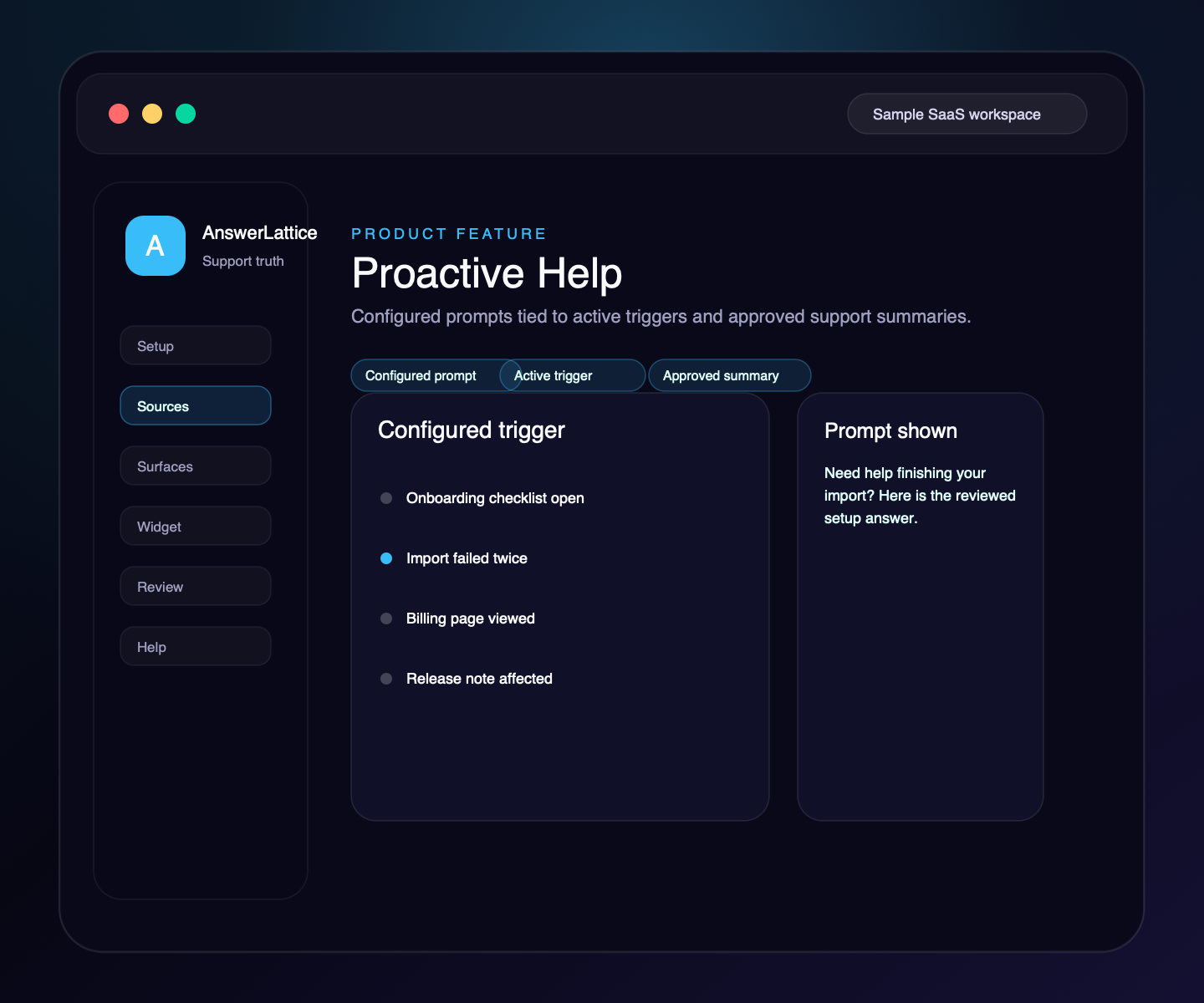
AnswerLattice can use owner-approved page triggers to suggest relevant help from the widget when active triggers exist for the current app page.
Widget, hosted help, tickets, and review
Drafts stay review work until approved
Shows what the feature changes in the support loop
Proactive Help
The widget should not guess or interrupt everywhere. AnswerLattice keeps proactive prompts tied to active triggers, safe page context, cached trigger summaries, and approved support content.
01 / Proactive Help
Use safe route, feature, workflow, plan, or role context to match a prompt to the screen where the user is working.
Resolved trigger summaries can point to reviewed answers or support content instead of running broad lookup on every page view.
Runtime configuration tells the widget whether proactive help is enabled, so inactive tenants avoid unnecessary API calls.
When no active triggers exist, negative caching avoids repeated backend checks for the same page context.
Allowed origins, blocked routes, and safe context rules still apply before any proactive prompt appears.
If a prompt is missing or weak, feedback and fallback can become support review work instead of invisible analytics noise.
Workflow
Proactive help stays owner-controlled: configure the page trigger, connect it to approved support, let the widget display it only when eligible, and review feedback.
Connect the route or workflow to the product surface where users need help.
Define when the widget should suggest help for that page context.
Attach reviewed support content or an approved answer summary.
The widget checks capability state before requesting proactive help.
Use feedback and fallback signals to improve the trigger or support content.
Connected product truth
A proactive suggestion is still support knowledge. It must stay scoped to product context, approved content, widget controls, and reviewable signals.
Proactive Help stays tied to reviewed sources, safe page context, and owner-approved support output.
Support content feeds the widget, hosted help, tickets, and answer review from one controlled workspace.
Owner-approved page triggers
The prompt appears inside the same safe in-app runtime controls.
Suggestions can point to reviewed answer summaries instead of free-form guesses.
Triggers stay attached to routes, workflows, and product areas.
Feedback and fallbacks keep proactive help reviewable.
Connected layer
A founder may start with proactive help, but the value comes from keeping it connected to setup, in-app support, hosted help, fallback, and approved-answer review.
Each feature is explained as something buyers already recognize: docs, FAQs, releases, tickets, feedback, notifications, or review work.
The feature does not live alone. It connects back to widget answers, hosted help, fallback, and owner review.
Drafts, generated content, ticket gaps, and feedback remain reviewable before anything becomes official support.
Create your workspace, add team access, teach AnswerLattice from starter sources, and map the pages where users need help.
Install one widget, pass safe page hints, accept explicit screenshot context, control allowed domains, and answer users inside your app.
Publish docs, FAQs, custom owner answers, and release notes; manage fallback tickets, feedback, ratings, and feature requests from one connected support layer.
Review drafts, repeated misses, stale answers, coverage, and readiness before support becomes official.
Worth checking
Answer the evaluation questions before setup: how it launches, what stays safe, and how it differs from nearby support tools.
Show how the feature fits into the widget, hosted help, fallback, and owner review before users depend on it.
View product mapReview safe page context, blocked private data, owner roles, fallback behavior, and approved-answer authority.
Review securitySee where AnswerLattice fits against chatbots, helpdesks, and static knowledge bases without treating them as the same product.
Compare optionsQuestions
No. It should appear only when configured and enabled for the workspace, with runtime capability checks preventing unnecessary calls when inactive.
No. Proactive prompts should point to approved support content or reviewable fallback paths. They do not publish new authoritative answers by themselves.
The runtime is designed to skip proactive calls when the feature is disabled and use trigger summaries and negative caching when no active triggers exist.
AnswerLattice works best when proactive help stays connected to widget answers, hosted help, tickets, and answer review.