Connected to
Widget, hosted help, tickets, and review
Tickets
AnswerLattice keeps tickets as a fallback and signal source. When approved knowledge is missing, tickets capture the issue, safe context, and resolution patterns that can become future support content.
Widget, hosted help, tickets, and review
Drafts stay review work until approved
Shows what the feature changes in the support loop
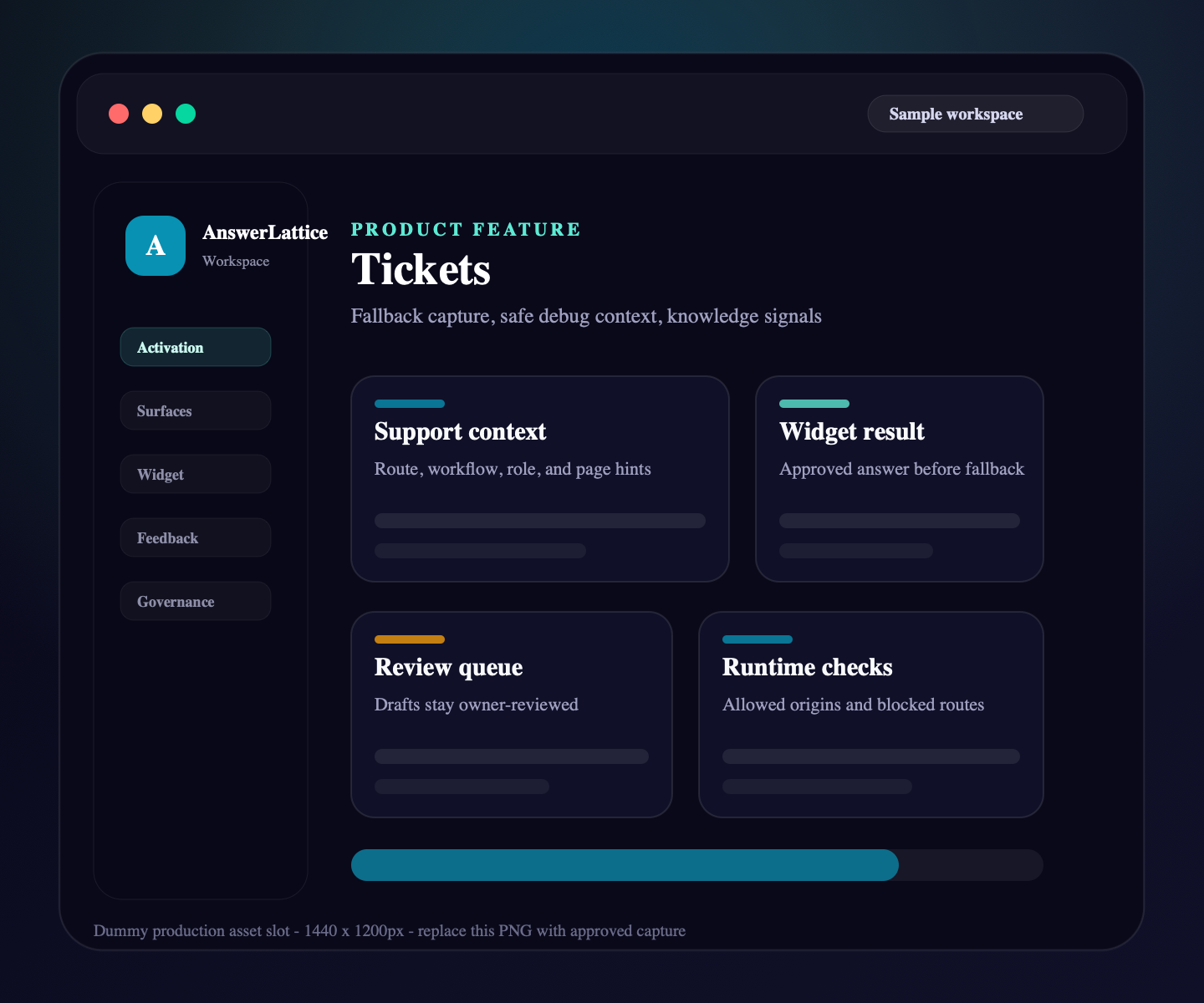
Tickets
Tickets should not become the center of the product. In AnswerLattice they are the practical fallback path and the evidence trail for improving approved-answer coverage.
01 / Tickets
Let users ask for help when approved answers or Help Center content cannot resolve the issue.
Attach bounded page, browser, and sanitized debugging context so owners avoid repeated technical questions.
Support teams can review, reply, and close tickets while keeping the workflow intentionally lightweight.
Resolved ticket patterns can become signals for new answers, article updates, or FAQ improvements.
The goal is not more ticket workflow. The goal is turning repeated tickets into approved support knowledge.
Workflow
Tickets close the support loop by capturing missing coverage and routing repeated issues into knowledge review.
Widget or Help Center fallback opens a ticket path.
Safe page and browser context reduces back-and-forth.
The support answer is handled through normal ticket response.
Resolved clusters can create draft knowledge changes for review.
Connected product truth
AnswerLattice uses tickets to improve support knowledge. That keeps the product aligned with answer review rather than becoming another helpdesk.
Tickets stays tied to reviewed sources, safe page context, and owner-approved support output.
Support content feeds the widget, hosted help, tickets, and answer review from one controlled workspace.
Ticket fallback when coverage is missing
Fallback can create a ticket from the same page context.
Resolved issues can become article improvements.
Repeated simple tickets can become short approved answers.
Ticket clusters feed signal-to-knowledge proposals.
Connected layer
A founder may start with tickets, but the value comes from keeping it connected to setup, in-app support, hosted help, fallback, and approved-answer review.
Each feature is explained as something buyers already recognize: docs, FAQs, releases, tickets, feedback, notifications, or review work.
The feature does not live alone. It connects back to widget answers, hosted help, fallback, and owner review.
Drafts, generated content, ticket gaps, and feedback remain reviewable before anything becomes official support.
Create your workspace, add team access, teach AnswerLattice from starter sources, and map the pages where users need help.
Install one widget, pass safe page hints, accept explicit screenshot context, control allowed domains, and answer users inside your app.
Publish docs, FAQs, custom owner answers, and release notes; manage fallback tickets, feedback, ratings, and feature requests from one connected support layer.
Review drafts, repeated misses, stale answers, coverage, and readiness before support becomes official.
Worth checking
Answer the evaluation questions before setup: how it launches, what stays safe, and how it differs from nearby support tools.
Show how the feature fits into the widget, hosted help, fallback, and owner review before users depend on it.
View product mapReview safe page context, blocked private data, owner roles, fallback behavior, and approved-answer authority.
Review securitySee where AnswerLattice fits against chatbots, helpdesks, and static knowledge bases without treating them as the same product.
Compare optionsQuestions
No. Tickets exist as fallback and signal source. AnswerLattice stays focused on support knowledge accuracy.
Only bounded, sanitized support context should be captured. Sensitive secrets and raw private data should not be collected.
No. Ticket learnings can create draft proposals, but owners approve knowledge before it becomes authoritative.
AnswerLattice works best when tickets stays connected to widget answers, hosted help, tickets, and answer review.