Context
Safe page context for relevant help
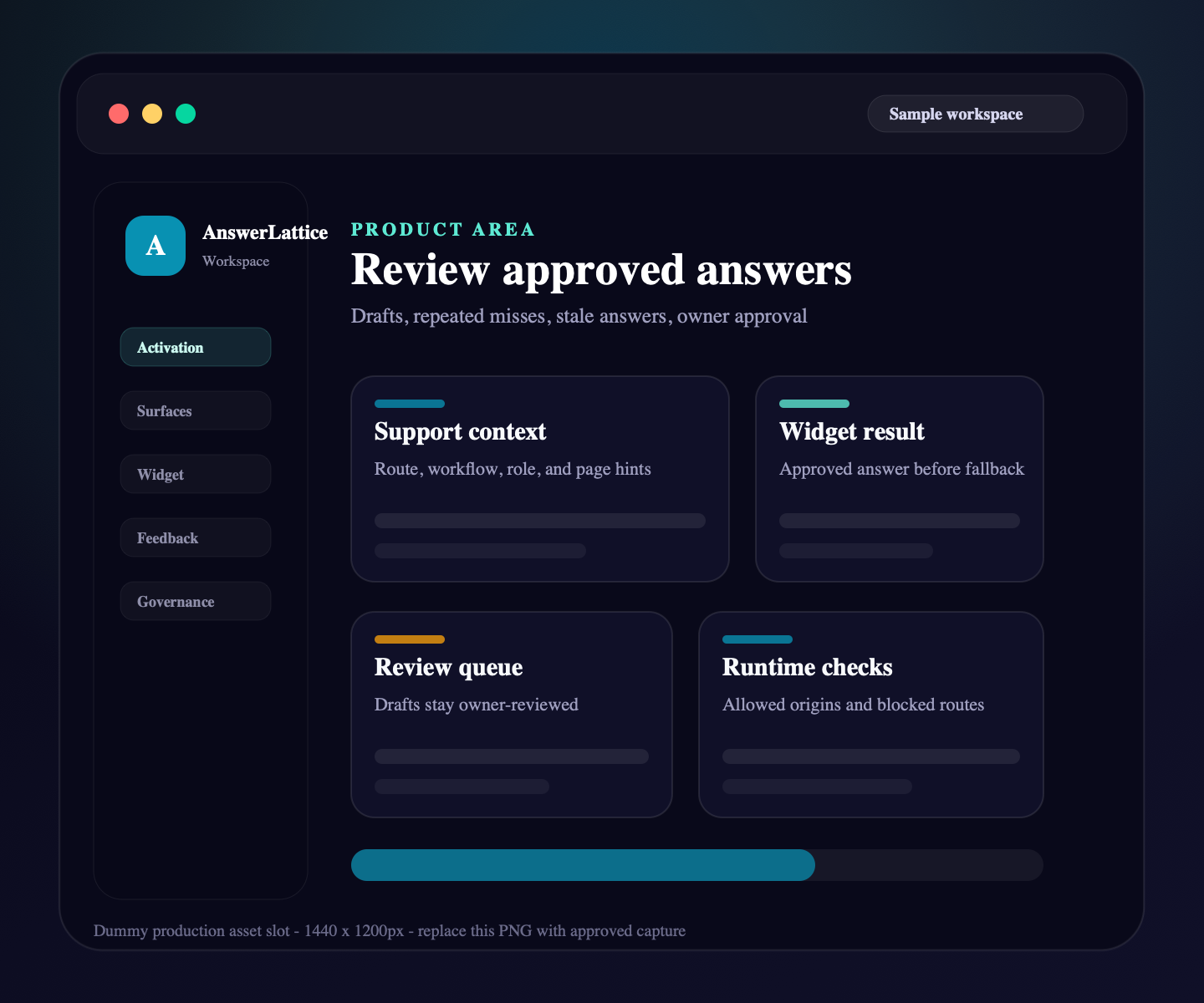
Review approved answers
AnswerLattice keeps approved answers in front, marks fallback clearly, flags stale support, and turns repeated misses into reviewable improvements.
Safe page context for relevant help
Approved answers before fallback
Owner approval before official guidance
Widget, hosted help, tickets, and signals connected
Where this fits
Founders can start with one support problem, then keep sources, user-facing surfaces, owner control, and support-gap review moving together.
Docs, product pages, FAQs, release notes, screenshots, tickets, and repeated replies become setup material.
The widget, hosted help center, FAQ, changelog, and ticket fallback share the same support layer.
Drafts and generated guidance stay review work until the owner approves what becomes official.
Fallback, ratings, feedback, and stale support turn into the next review pass.
What this gives the owner
The point is not to let AI answer everything. The point is to keep known answers stable, stale answers visible, and missing answers reviewable.
01 / Review approved answers
Features, plans, roles, workflows, states, integrations, and errors can be treated as first-class support concepts.
Safe page context for relevant help
Approved answers before fallback
Owner approval before official guidance
Widget, hosted help, tickets, and signals connected
Drafts and proposals do not become official answers until a human approves them.
AnswerLattice makes stale answers visible after releases, scope conflicts, or deprecated product behavior.
Owners can see whether important surfaces have enough approved answers.
Summary-backed metrics help the owner understand readiness without scanning raw logs.
Workflow
The review loop is simple: approved answer first, fallback when needed, signal when weak, owner review, then a better answer for the next user.
If approved knowledge matches the page and scope, AnswerLattice uses it before fallback.
Fallback is useful, but it is not treated as official support guidance.
Tickets, low-confidence answers, and negative feedback expose recurring support gaps.
Owners approve, refine, or reject draft improvements before publishing.
Approved changes increase coverage and reduce repeated support load.
Before you launch
Remove evaluation doubt with setup, security, and category-fit checks that stay tied to the implemented product.
Check the widget contract, framework guides, safe context rules, and verification path before launch.
Open install guideReview what the widget can see, what stays blocked, and how owner-approved answers remain authoritative.
Review securityCompare AnswerLattice with chatbots, helpdesks, and static knowledge bases before choosing the support layer.
Compare options